The engine's read
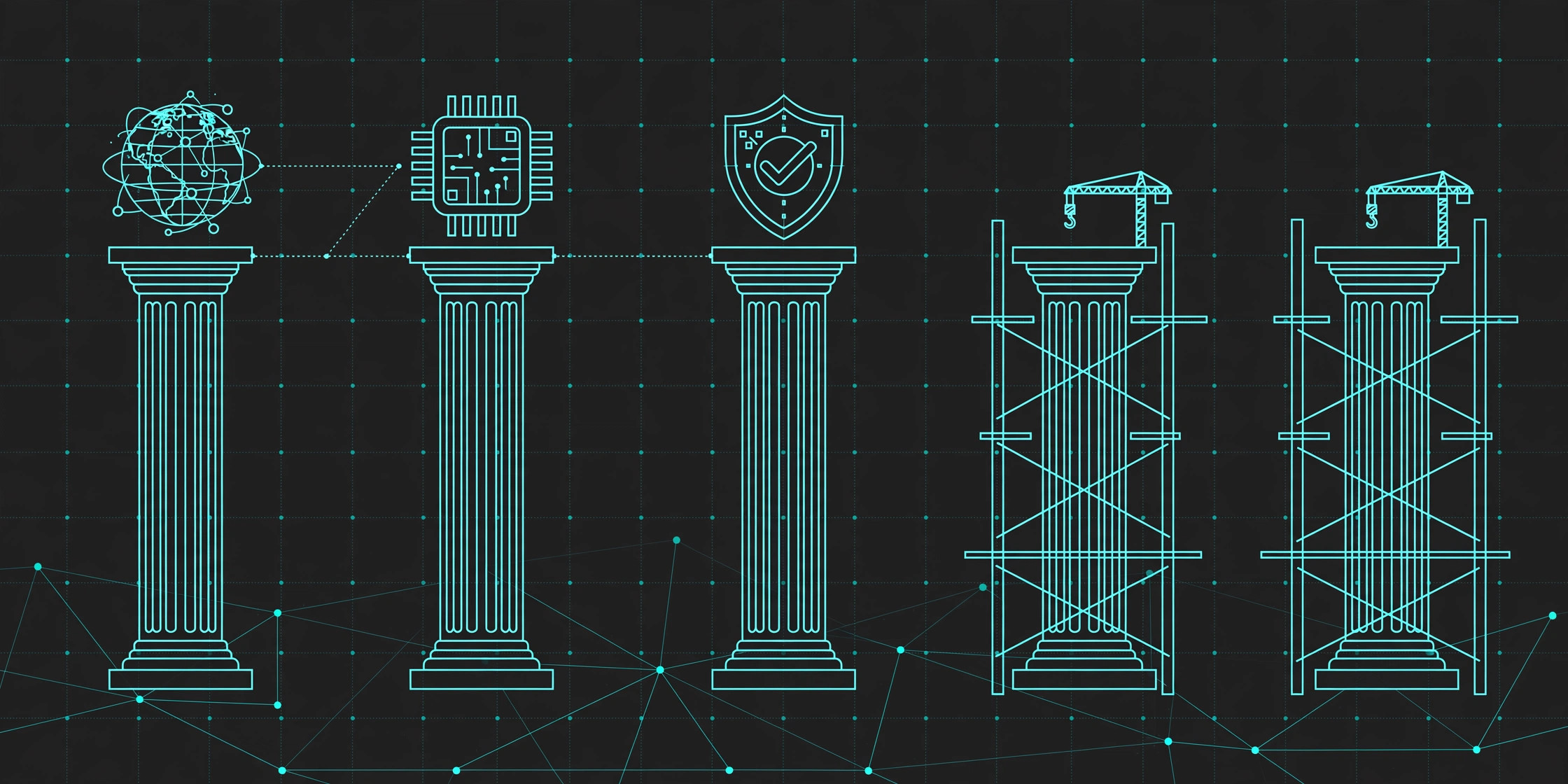
The five-pillar analysis is DalalBytes' engine for grading a business on the five traits that compound wealth: a sunrise sector, leadership, a moat, an iron-fortress balance sheet, and real free cash flow. Akamai passes three of the five as of September 24, 2026, with both non-negotiables intact and both partials carrying the same cure: contracted revenue converting to cash as capacity goes live. Hours before this analysis, Anthropic committed $11.6 billion over seven years (expandable to ~$20 billion) for Akamai cloud capacity, explicitly for CPU workloads. It is the market's first large-scale validation of the distributed-inference thesis, and it landed on a stock priced as a melting CDN ice cube: $110.40 at the close, down 6.8% on the day, then ~$129 after hours, up 17%.
Pillar 1: Sunrise sector PASS
The sunrise is not "cloud" generically. It is distributed inference for agentic AI: CPU-heavy orchestration workloads running at the edge, where latency and per-token economics beat centralized AI factories. Anthropic's $11.6 billion commitment is explicitly for CPU workloads on Akamai's distributed cloud. That single contract term is the thesis in one line. Cloud Infrastructure Services is the growth engine proving it: $174M (2023) to $230M (2024, +32%) to $314M (2025, +36%) to +39% year over year in H1 2026. Before Anthropic, Akamai had already signed more than $2.8 billion in multi-year CIS commitments in 2026 alone: $200M for a Blackwell GPU cluster (March), $1.8B from a frontier-model provider (May), and over $600M for robotics development (August). The cadence, $200M to $1.8B to $600M to $11.6B, is the template replicating. Frontier labs are assembling portfolios of compute rather than renting from one cloud, and more customers will come. Security ($2.24B, +9.8%, the majority of revenue since 2024) is the third leg and it is durable growth, not legacy: enterprise AI inference has to be secured at the point of contact. The honest asterisk: legacy Delivery is still roughly a third of revenue and shrinking 5 to 15% a year on price erosion. The sunrise engine is real; the mix is mid-transition.
Pillar 2: Leadership PASS
Tom Leighton is a co-founder (1998) and CEO since January 2013: a founder-scaler, the strongest leadership archetype in the engine. He has led Akamai through three reinventions, delivery to security to cloud, scaling revenue from under $1.4B at his appointment to $4.2B. Did what he said: the $900M Linode acquisition (2022) was bought to accelerate cloud, and CIS growth accelerated (+32%, +36%, +39%); 2024 compute revenue grew 25% against 21-23% guidance, a beat. The near-miss on record is phrasing, not substance: his "well over half a billion" 2023 cloud call landed at $504M. His current forward line, growth accelerating from single digits to low-teens in 2027 on multi-year contractual commitments, is the next prove-it. Watch: age 69, no named successor disclosed.
Pillar 3: Moat PASS
4,300 to 4,400 points of presence in 130+ countries, 175+ Tbps of capacity: twenty-five years of operating the world's largest edge network. That footprint cannot be built on a venture timeline, and Anthropic's choice is revealed preference: for SLA-bound CPU inference at global scale, the distributed footprint beat building with hyperscalers. Akamai is also simply unavoidable internet plumbing: the platform is integrated with roughly 1,200 network partners worldwide, and its stated cloud pitch leads with generous egress allowances, a direct attack on the egress-fee economics of hyperscalers and GPU neo-clouds. For inference workloads that move data constantly, that pricing edge compounds. The moat deepens further with the security portfolio (Guardicore $600M, Noname $450M), which hardens exactly where AI workloads need it. Watch: Cloudflare (Workers plus edge-security mindshare) is the credible well-funded competitor; hyperscalers and GPU neo-clouds flank from both sides.
Pillar 4: Iron fortress PARTIAL
Net debt of roughly $2.95B (~1.7x adjusted EBITDA) with $4.6B of cash and marketable securities and an investment-grade rating: manageable, but this is not a fortress today. $1.725B of May 2033 converts are classified as current because holders can elect conversion, though contractual maturity remains May 2033, the Anthropic build needs an estimated $5.5B of capex (+$1.7B in 2026 alone, including a $1.7B Jabil memory authorization), and the buyback was suspended to fund the growth. Management is deliberately spending the fortress on the largest buildout in company history. The path: the spend is de-risked by contract. Multi-year committed revenue, with payments tied to delivery milestones, converts the capex into contracted cash flow. If delivery hits, the fortress rebuilds itself.
Pillar 5: Free cash flow PARTIAL
Free cash flow is compressing through the buildout: $834M (FY24) to $699M (FY25) to ~$440M annualized in H1 2026, with GAAP operating margin down to 9.0% on depreciation, colocation, and headcount for the CIS expansion. The company guided no 2026 revenue impact from Anthropic, which means 2027 onward is the proving ground. Contracted revenue against already-spent capex is the classic FCF inflection setup. Credible path, not current proof.
The "first inference cloud" angle
Akamai (1998) built the first globally distributed edge-compute platform; EdgeWorkers ran code at the edge before "serverless" was a word. (Honest dating: utility cloud as we know it starts with AWS in 2006. Akamai invented the distributed half.) "First inference cloud before the word inference was born" is the poetic version of a real technical point: twenty-five years optimizing time-to-first-byte for billions of concurrent personalized responses is exactly the skill inference needs. Now it is time-to-first-token. As one analyst put it: training is centralized, inference is distributed by nature, and the network that already moved YouTube and Netflix to billions of users is suddenly the network that moves Claude. The intersection is the sharpest part of the thesis. Agentic AI workloads are CPU-heavy orchestration: tool calls, routing, batching, and memory management around the models. Anthropic paying $11.6B specifically for CPU workloads confirms where the money goes. Agents need three things: low latency (edge), cheap massive concurrency (distributed CPU, not scarce GPUs), and hardened enterprise surfaces (security, Akamai's $2.24B business). All three legs are Akamai strengths. The lane: not training (neo-clouds, hyperscalers), not centralized inference, but enterprise distributed inference, SLA-bound and CPU-heavy. The Anthropic deal is the first proof it is a $10B+ lane.
Valuation and scenarios
At the $110.40 close, Akamai traded at roughly 40x trailing earnings, ~10.7x EV/adjusted EBITDA, and a ~4.0% free-cash-flow yield: the market priced a melting ice cube. At ~$129 after hours, that becomes ~19x forward non-GAAP EPS ($6.73 midpoint) and ~12x EV/adj. EBITDA. The deal reprices the growth engine; the multiple is no longer distressed, but it is not demanding if 2027 low-teens growth lands. Unlike the GPU neo-clouds building on leverage and losses, Akamai brings $4.21B of revenue, $452M of GAAP net income, and $699M of free cash flow to the AI infrastructure fight. The buildout is funded by a profitable business, not by hope. Scenarios for 2028: bear ~$95 (execution stumbles, multiple compresses); base ~$150-165 ($11.6B delivers on schedule, 2027 growth lands); bull ~$200+ (the $9B expansion vests, more frontier customers sign, edge inference standardizes).
Key risks
Concentration is the single largest risk: Anthropic is ~2.75x FY2025 revenue in one customer's hands, with SLA-gated payments and termination on material outage. Execution is the second: the largest buildout in company history, gated on memory and GPU supply chains. Then legacy erosion (Delivery still shrinking), Cloudflare, ~5% warrant dilution at $111.33, and succession (Leighton is 69 with no named successor).
What changes the verdict
Up toward 80+: 2027 revenue growth hits low-teens with CIS ex-Anthropic still above 30%, turning both partials into passes. Down, thesis breaks: SLA failure with penalties, or Anthropic concentration without customer diversification by end-2027. The two numbers that decide it: quarterly CIS revenue ex-Anthropic (is the engine real beyond one customer?) and capex as a share of revenue (is the build converting to cash?).
Bottom line
Three of five pillars pass on evidence, both partials carry contracted-revenue paths, and both non-negotiables are intact. Akamai spent 25 years becoming unavoidable internet plumbing; the Anthropic deal suggests the same footprint is now the cheapest at-scale home for the CPU-heavy inference workloads agentic AI actually runs on. Real revenue, real profits, and the first proof that distributed inference is a $10B+ lane. Watch next: delivery milestones on the Anthropic build, the Q3 10-Q's full agreement texts, and whether a second frontier-scale customer signs.