
Frequently asked questions
Is Premier Polyfilm a buy at current prices?
DalalBytes rates Premier Polyfilm Selective Positive at 65/100. At Rs 84.93 the stock trades at 24.2x trailing earnings and 27.9x FY26 earnings. The business is strong, with FY26 PAT of Rs 31.88 cr, nil borrowings at September 2026 and promoters buying up to 70.81%, but the stock is up 124% from its 52 week low, Q2 FY27 margin compressed to 14.17% on a resin spike, and inventory days have reached 99.
What are Premier Polyfilm FY2029 price targets?
DalalBytes FY2029 targets for Premier Polyfilm are bear Rs 55, base Rs 105 and bull Rs 175, from a Rs 84.93 reference price. Bear: 8% sales CAGR to Rs 374 cr, PAT of Rs 36 cr, EPS of Rs 3.39 at 16x. Base: 15% CAGR to Rs 451 cr, PAT of Rs 50 cr, EPS of Rs 4.74 at 22x. Bull: 22% CAGR to Rs 539 cr, PAT of Rs 65 cr, EPS of Rs 6.17 at 28x.
Why did Premier Polyfilm go through BIFR, and what changed after?
Premier Polyfilm entered BIFR in the early 2000s and its face value was cut from Rs 10 to Rs 2.50 in 2003 under BIFR orders, before a consolidation back to Rs 5 in 2009 and a 5 for 1 split to Rs 1 in November 2024. The rebuilt company runs with almost no debt: borrowings were nil at September 2026, debt to equity was 0.13 in FY26, and operating margin rose from 9% in FY22 to 16% in FY26 as low margin product lines were discontinued.
What is the verdict on Premier Polyfilm?
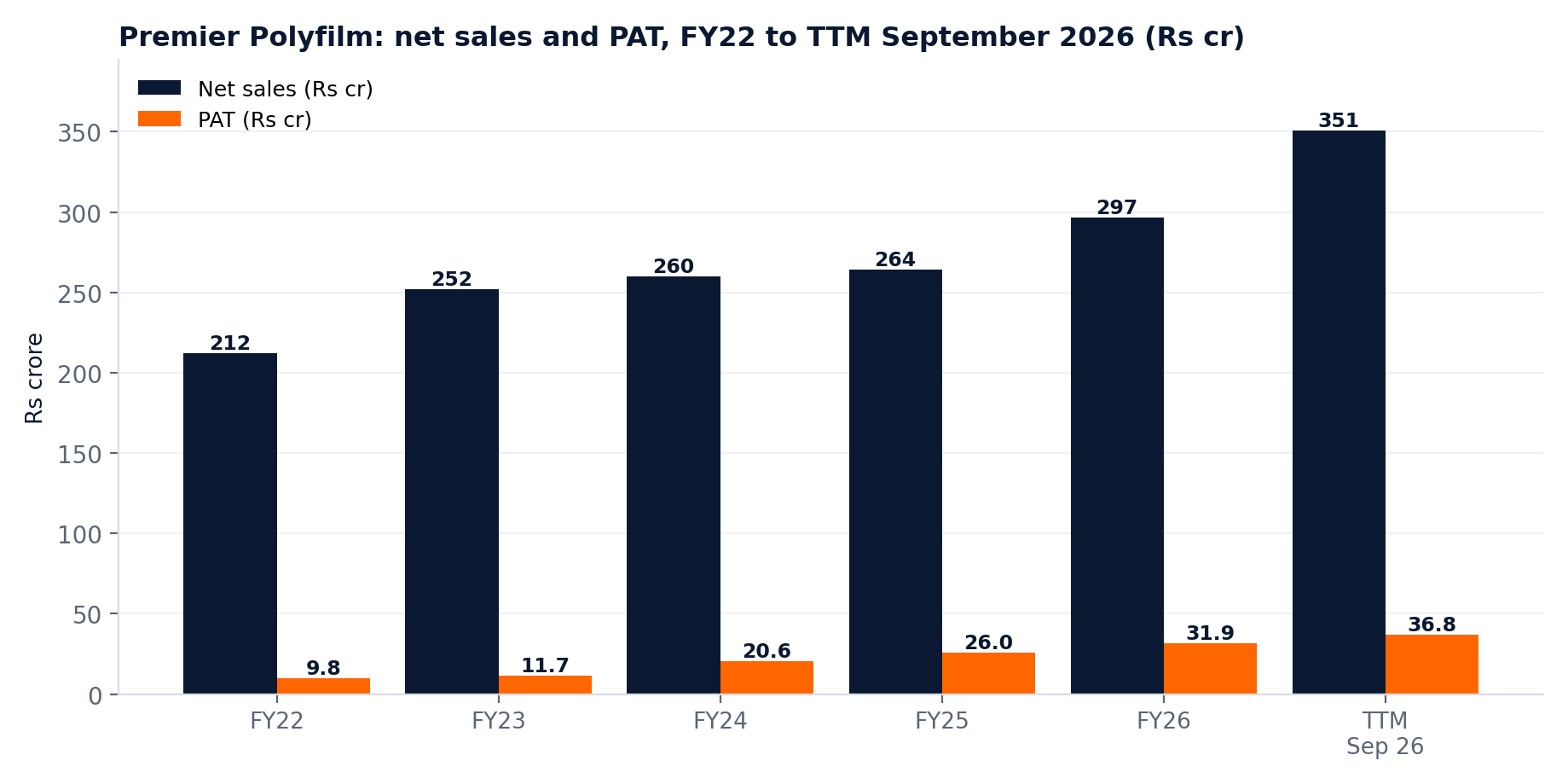
Premier Polyfilm is a 33 year old calendered PVC maker that has already died once. It went through BIFR in the early 2000s and had its face value cut from Rs 10 to Rs 2.50 in 2003. The company that came back lifted operating margin from 9% in FY22 to 16% in FY26 and PAT from Rs 9.78 cr to Rs 31.88 cr, on net sales that rose only from Rs 212 cr to Rs 296.58 cr. The second act is volume: H1 FY27 gross revenue grew 36.5% year on year and H1 PAT grew 34.8%, and promoters bought their holding up from 67.60% to 70.81% in 2026. At Rs 84.93 the stock pays 24.2x trailing earnings for that act, 29% below its Rs 120 high and 124% above its Rs 38 low. Selective Positive.
How did Premier Polyfilm start, and what happened in BIFR?
Premier Polyfilm was incorporated on July 17, 1992 and began operations in 1993, promoted by Amar Nath Goenka and A K Surekha. A rights cum public issue in 1995 part financed a 9,600 tpa calender line and took capacity to 16,200 tpa. The company then went through BIFR: face value was cut to Rs 2.50 in 2003, consolidated back to Rs 5 in 2009, and split 5 for 1 to Rs 1 in November 2024. The Goenka family kept control through the rescue. Amitaabh Goenka has been Managing Director and CEO since September 2022, and his son Mayank Goenka joined the board as Executive Director in July 2025.
What does the business actually do?
Premier reports one segment: flexible PVC flooring, film and sheets, made by calendering with coating, printing, lamination and embossing in house. Flooring is the flagship: railway coach flooring, safety flooring, heavy duty commercial flooring, anti static grades and the Electromat insulating mat line. Artificial leather cloth from the Sikandrabad plant serves auto and transport seating, and IATF 16949 certification is the entry ticket to those supply chains. The range also covers PVC films, Aqualining geomembranes, POLYSWIM pool liners and Walltastic wallpaper. The technical heart is the railway niche: Premier is one of only three RDSO and RCF approved vendors for railway coach PVC flooring, alongside Responsive Industries and RMG Polyvinyl India.
Where does the revenue come from?
Domestic demand carried FY26 in full. Net sales were Rs 296.58 cr, up 12.5%, while exports fell 19% to Rs 27.79 cr, about 8 to 9% of sales. Production rose to 29,311 MT from 28,383 MT. The company presents revenue inclusive of GST in its results, Rs 338.90 cr for FY26 on that basis, and this report uses the net of GST series throughout so margins stay comparable. The new Tamil Nadu unit at Cheyyar now buys finished flooring and leather locally and bills southern sales on the company account. That is trading revenue, not manufacturing revenue, and it will flatter growth while it dilutes margin.
What do the financials show?
Net sales went Rs 212 cr, Rs 252 cr, Rs 260.09 cr, Rs 264.13 cr and Rs 296.58 cr across FY22 to FY26, with operating margin of 9%, 9%, 13%, 14% and 16%, and PAT of Rs 9.78 cr, Rs 11.68 cr, Rs 20.60 cr, Rs 26.00 cr and Rs 31.88 cr. The Directors Report names the recipe: sub optimal margin lines were discontinued and high profitability categories took the capacity. Q2 FY27 is the quarter to hold in mind: filing basis revenue rose 38.3% year on year to Rs 115.06 cr, the cost of materials consumed rose 64.2%, PAT rose only 22.5% to Rs 9.81 cr, and operating margin on the net basis compressed from 16.70% to 14.17%. That is the commodity risk of this business, demonstrated live.
How strong is the balance sheet and cash flow?
Net worth was Rs 147.20 cr at March 2026 and Rs 167.75 cr by September 2026. Borrowings were Rs 19 cr at March 2026 and nil at September 2026 on the filing basis, with cash and investments of Rs 19.4 cr. Debt to equity was 0.13 in FY26 and interest coverage was 57.4x on Crisil figures. Operating cash flow was Rs 26.70 cr in FY26 and free cash flow was Rs 17.7 cr, about 55% of PAT, with plant capex of about Rs 9 cr. The watch item is inventory: stocks jumped 57% in FY26 to Rs 50.27 cr, inventory days rose from 43 to 99 in two years, and the cash conversion cycle stretched to 109 days, while debtor days held near 51.
Who owns Premier Polyfilm, and what happened with pledging?
Promoters held 67.37% to 67.60% for two years, then bought in the open market through 2026: 69.39% at March 2026, 71.09% at June 2026 and 70.81% at September 2026. D L Millar and Co, a promoter group company, holds about 15.2%. Amitaabh Goenka holds 12.04% after buying 47,825 shares on October 26 and 27, 2026. Pledging reads 0.00% in every quarter with one exception: 0.03% in March 2026, when the DP pledged 21,882 D L Millar shares after purchases made without adequate margin, an accident the company disclosed in a revised filing on April 7, 2026 and which was gone by June 2026. FII holding is 0.09% and DII holding is 1.02%.
What is Premier Polyfilm worth versus peers?
At Rs 84.93: P/E 24.2x trailing on EPS of Rs 3.52 and 27.9x on FY26 EPS of Rs 3.04, P/B 5.3x on book value of Rs 16.0, P/S 2.5x on trailing net sales. Responsive Industries trades near 36.6x with FY26 sales of Rs 1,394 cr and ROE of 10.3%. Mayur Uniquoters trades at about 14.0x on sales of Rs 967 cr, PAT of about Rs 191 cr and an operating margin of 21.2%. Royal Cushion Vinyl, the BSE only legacy name, is loss making on sales of Rs 56 cr. Premier's premium to Mayur rests on growth: trailing sales up about 29% and trailing profit up about 40%. FY2029 scenarios: bear Rs 55, base Rs 105, bull Rs 175.
What are the key risks?
First, the raw material: PVC resin is a crude derivative, a major share is imported, and the exposure beyond the export hedge is kept unhedged, so a spike lands on the margin line first, as Q2 FY27 showed. Second, working capital: inventory days of 99 and a 109 day cash cycle mean growth funds itself from the balance sheet. Third, a single chemistry: everything is PVC, exports fell 19% in FY26, and the 2023 anti dumping duty on vinyl tiles excludes roll and sheet form, so it does not protect the core product. Fourth, disclosure: no guidance and no earnings calls, an undisclosed total capex for Cheyyar, a six week ICRA Issuer Not Cooperating episode in 2026 that ended in an upgrade to A-, and a Rs 50,000 exchange fine for a late XBRL filing.
© 2026 DalalBytes Research · For educational purposes only. Not investment advice.